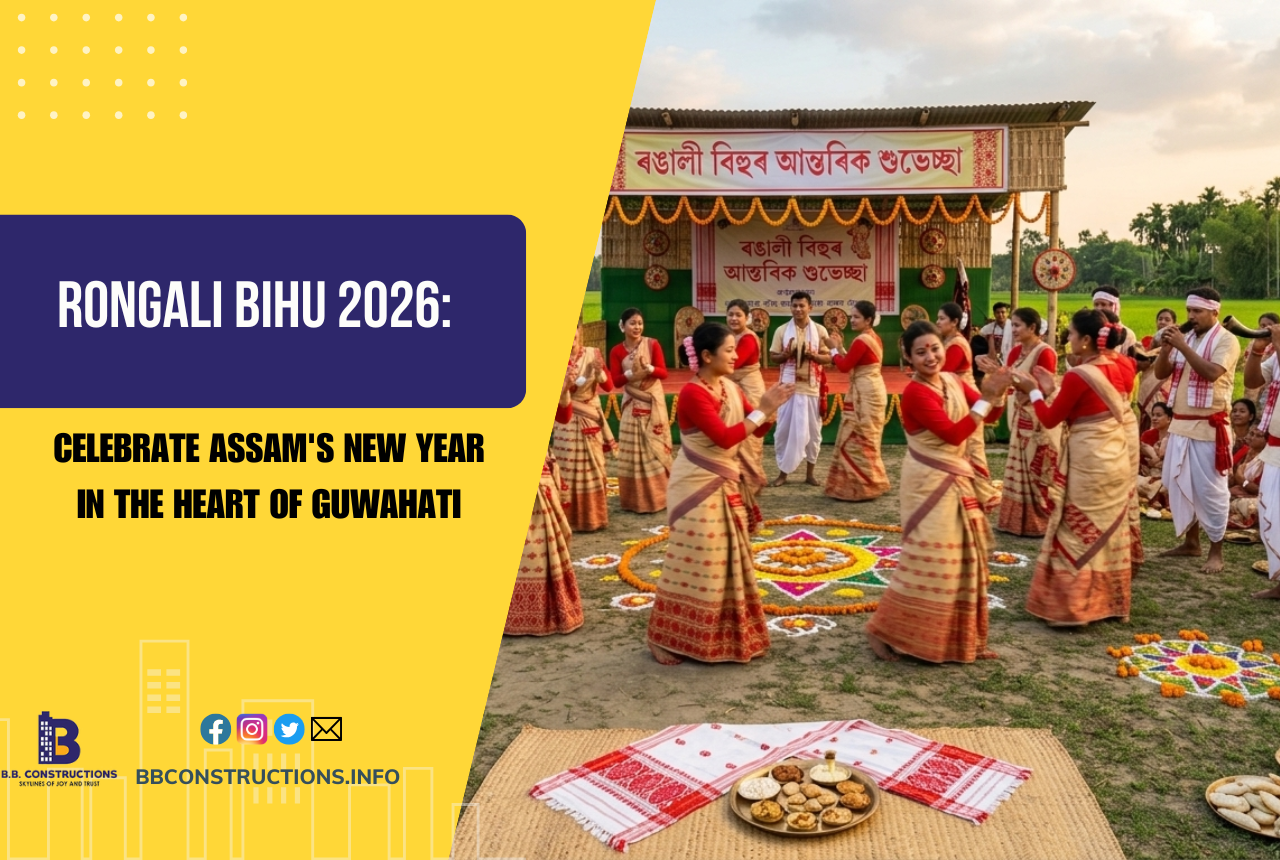

Every April, something magical happens in Assam. The dhol begins to thunder. Orchids bloom in doorways. The smell of pitha drifts through neighbourhoods. And across Guwahati — from Sixmile to Garchuk, from Beltola to Betkuchi — communities pour into open grounds, dressed in their finest, ready to welcome a brand new year.
This is Rongali Bihu 2026 — and there is no better place on earth to feel its joy than right here in Guwahati.
Whether you are a lifelong Assamese or someone who has recently made this vibrant city your home, this guide covers everything you need to know about Rongali Bihu 2026: the date, its meaning, the 7 types, festive wishes, and how Guwahati celebrates like nowhere else.
When Is Rongali Bihu 2026?
Bohag Bihu 2026, also known as Rongali Bihu, will be celebrated from Tuesday, 14th April to Monday, 20th April 2026, marking the beginning of the Assamese New Year and the arrival of spring.
Bohag Bihu is a regional public holiday celebrated in the Indian state of Assam on April 14th each year, and it is also sometimes a public holiday in the neighbouring state of Arunachal Pradesh.
Mark your calendars, decorate your doorways with mango leaves, and get ready — Bihu season is almost here.
What Is Rongali Bihu? Meaning and Origin
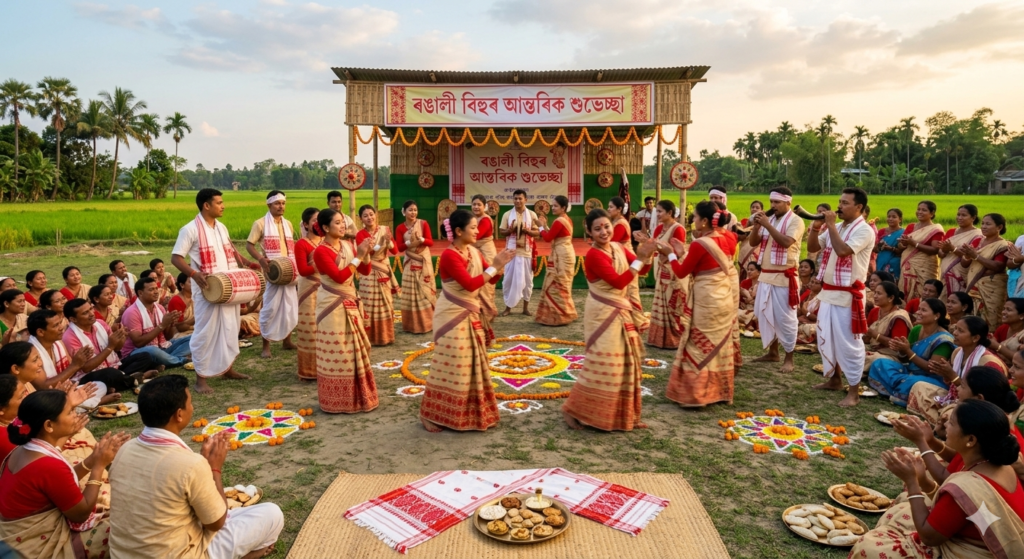
Rongali Bihu, also called Bohag Bihu, means “festival of joy.” It is celebrated at the start of the Assamese month of Bohag when the old year ends and a new one begins. The word “Rongali” comes from “Rong,” which means happiness or colour, showing that the festival is full of cheerful shades.
The meaning of Bihu has its origins in the Sanskrit term ‘Bishu,’ which suggests ‘to ask blessings and prosperity from the Gods’ during the harvest season of Assam. The Bihu festival history dates back to pre-Aryan days, approximately around 3500 BC.
For centuries, Bihu has been the thread that holds Assamese life together — a celebration that crosses religions, communities, and generations. In a city like Guwahati, where old roots meet new possibilities, Bihu is a reminder of what truly matters: family, community, and the warmth of home.
The Significance of Rongali Bihu
Rongali Bihu is not just a festival but a celebration of Assam’s identity, culture, and unity. It brings people together beyond caste and religion, promoting harmony and shared traditions. With growing recognition, it also plays a key role in boosting cultural tourism and preserving heritage.
Bihu rises above the boundaries of religion, caste, and class. It unites people through shared culture, music, traditional and agricultural roots. Recognized as an important part of India’s incorporeal cultural heritage, Bihu represents sustainable living and respect for nature.
There is something profound about celebrating Bihu in Guwahati in 2026. This city — the gateway to Northeast India — is in the midst of a remarkable transformation. New communities are forming, new skylines are rising, and more families are choosing to plant permanent roots here. The spirit of Rongali Bihu — renewal, fresh starts, and joyful togetherness — mirrors exactly what it feels like to find your forever home in this city.
At BB Constructions, we have spent over a decade building homes across Guwahati not just as structures, but as spaces where memories like these are made. Bihu mornings with family. New year blessings from elders. The sound of the dhol drifting in through a window. These are the moments that a home makes possible.
What Are the 7 Types of Rongali Bihu?
One of the most fascinating aspects of Bohag Bihu is its seven-day structure. Bihu is celebrated over a span of seven days, with seven phases: Chot, Raati, Goru, Manuh, Kutum, Mela, and Chera. Each day has its own purpose, its own ritual, and its own beauty.
1. Chot Bihu — Preparation The pre-festival days when homes are cleaned, sweets are prepared, and new clothes are laid out. There is no better time to appreciate the home you live in.
2. Raati Bihu — The Night Celebration Rati Bihu was held under a tree or in the middle of a dense bamboo grove at night, where Bihu songs are sung under open skies with torchlight. An ancient, soul-stirring tradition that connects us to the land.
3. Goru Bihu — Cattle Day On this day, the household cattle are taken to the river and bathed, and people pray for the wellbeing and safety of their livestock. It is a beautiful expression of gratitude for everything that sustains us.
4. Manuh Bihu — Elder Day “Manuh Bihu” involves the tradition of seeking blessings from the elders in a family and presenting the ceremonial Gamusa cloth as a gift, to be worn as a symbol of cultural pride. In a world that moves fast, this day is a gentle reminder to honour those who came before us.
5. Kutum Bihu — Family Day On Kutum Bihu, people visit their families, relatives, and friends and have lunch or dinner together and share news and stories. This is Bihu at its most intimate — gathered around a table, in a home that feels like belonging.
6. Mela Bihu — The Grand Fair The third day of Bihu is marked by the celebration of Bihu with cultural events and competitions in outdoor locales. Guwahati’s Judges Field and Latasil Ground come alive with performances, competitions, and thousands of celebrating families.
7. Chera/Sera Bihu — Farewell to Festivities Sera Bihu, the concluding day, symbolizes farewell to festivities with sharing of sweets. Resolutions are made, gratitude is expressed, and the new year truly begins.
The Soul of the Festival: Dance, Music & Food
Bihu Dance
The Bihu dance is an indigenous folk dance from Assam, performed in a group consisting of young men and women, and their dancing style is characterised by brisk steps and rapid movement of the hands.
The female dancers wear Muga Riha, Mekhela, and traditional Assamese jewellery, and adorn their hair with Kopouphul (Foxtail orchid). The men wear a dhoti, Muga shirt, Bihuwan, and Tongali.
Traditional Bihu Food
Rongali Bihu festivities demand that traditional meals be prepared and shared with family, friends, and neighbours, ranging from pitha to protein-rich dishes. Pitha of many types — narikal pitha (coconut), til pitha (sesame), and tekeli pitha — are prepared specifically for feasts.
A warm Bihu feast shared with neighbours is one of the great joys of community living. It is the kind of moment that happens most naturally when you live in a well-designed residential society — where neighbours are close, spaces are shared, and the festive spirit comes alive naturally.
At BB Constructions projects like BB Utthan in Garchuk and BB Fortune in the heart of the city, residents experience this community magic every day — and especially during Bihu season.
Rongali Bihu Wishes in Assamese
Sending warm wishes is one of the most cherished Bihu traditions. Share these with your loved ones this season:
- “Subho Bihu!” — Happy Bihu! — The most universal Bihu greeting
- “Nôbôbôrsôr Subhechha!” — Happy New Year in Assamese
- “Rongali Bihur Ulohas aru Subhechha!” — Wishing you festive joy and blessings on Rongali Bihu!
- “Apunar jiwanat sukh, shanti aru samridhi aahuk” — May peace, happiness, and prosperity fill your life
- “Bihu aahil, ananda aahil” — Bihu has come, joy has come
Rongali Bihu 2026 in Guwahati: Where the Celebration Shines Brightest
Guwahati hosts large cultural exhibitions and Bihu melas at Judges Field and Latasil Ground, drawing thousands of families from across the city and the state. From Husori performances to Bihu dance competitions, the city is at its most vibrant and welcoming during this time.
With the help of social media and digital platforms, people across the world now celebrate and share the spirit of Bihu. Assamese communities living in different parts of India and abroad organise their own Bihu events to keep their traditions alive.
But for those who call Guwahati home, nothing compares to celebrating Bihu here — in this city where tradition and modernity walk side by side, where the Brahmaputra flows wide and golden, and where every neighbourhood becomes a Bihutoli for a week.
Celebrate Bihu in a Home That’s Truly Yours
Rongali Bihu is about new beginnings. And what better new beginning than a home of your own in Guwahati?
At BB Constructions, we have been building homes that Assamese families are proud to celebrate Bihu in — for over a decade. From spacious 2 BHK and 3 BHK flats in prime locations like Garchuk, Betkuchi, and Sixmile, to properties equipped with modern amenities, earthquake-resistant construction, CCTV security, 24/7 water and power backup, and ample parking — we build not just apartments, but communities.
This Bihu season, if you have been thinking about owning your dream home in Guwahati, let this new year be the year you make that move.
🏠 Explore BB Constructions’ projects and available flats in Guwahati — and start the Assamese New Year in a home built for your family’s happiness.
Conclusion: A New Year, A New Home, A New Chapter
Rongali Bihu 2026 is a celebration of everything that Assam holds dear — community, gratitude, joy, and the promise of a fresh start. Whether you are dancing at a Bihutoli, sharing pitha with neighbours, or sitting quietly on your balcony listening to the distant dhol — Bihu reminds us that home is where life’s most beautiful moments happen.
At BB Constructions, we build homes so those moments have a place to live in.
Subho Bihu to every family in Guwahati and beyond! 🌸🥁
From all of us at BB Constructions — wishing you a year full of joy, prosperity, and the warmth of a home that truly feels like your own.
Frequently Asked Questions (FAQ)
Q1. When is Rongali Bihu 2026? Rongali Bihu 2026 is celebrated from 14th to 20th April 2026, with April 14 being the main public holiday in Assam.
Q2. What is the significance of Rongali Bihu? Rongali Bihu marks the Assamese New Year and the start of the agricultural sowing season. It is a celebration of renewal, community, cultural identity, and gratitude — bringing all of Assam together regardless of religion or background.
Q3. What are the 7 types of Rongali Bihu? The seven phases are Chot, Raati, Goru, Manuh, Kutum, Mela, and Chera/Sera Bihu — each carrying its own unique ritual and social significance across the week.
Q4. What is the Assamese New Year called? The Assamese New Year is called Bohag Bihu or Rongali Bihu, celebrated every mid-April at the start of the Assamese month of Bohag.
Q5. What are the best Rongali Bihu wishes in Assamese? The most popular wishes are “Subho Bihu!” (Happy Bihu) and “Nôbôbôrsôr Subhechha!” (Happy New Year in Assamese). You can also say “Apunar jiwanat sukh, shanti aru samridhi aahuk” — wishing peace, happiness, and prosperity.
Q6. How is Goru Bihu celebrated? On Goru Bihu, cattle are bathed in rivers, blessed, and offered special food as a mark of agricultural gratitude. It is one of the oldest and most symbolic rituals of the festival.
Q7. What traditional foods are eaten during Rongali Bihu? Popular Bihu foods include pitha (rice cakes), laru (sweet balls), doi-chira (curd and flattened rice), and a medicinal dish made from 101 locally gathered herbs believed to strengthen immunity.
Q8. Where are the best places to celebrate Bihu in Guwahati in 2026? Judges Field, Latasil Ground, and neighbourhood Bihutolis across the city are the top spots. Guwahati’s residential communities also host their own cultural programmes, making it a truly city-wide celebration.
Q9. Is Bihu celebrated outside Assam? Yes. Assamese communities across India and internationally organise Bihu events every year, keeping the cultural flame alive through dance performances, community feasts, and digital celebrations.
Q10. How can I buy a flat in Guwahati near the Bihu celebrations? BB Constructions offers RERA-approved 2 BHK and 3 BHK flats in prime Guwahati locations, including Garchuk, Betkuchi, and Sixmile. Visit bbconstructions.info or call +91 90165 53399 to book a site visit this Bihu season.