
A Flood Safe Flat in Guwahati should be evaluated on much more than which floor you live on.
When buying a home in Guwahati, most people naturally compare location, price, carpet area, amenities and builder reputation. But there is another factor that deserves serious attention: how the property and its surrounding locality perform during heavy rainfall.
Guwahati experiences recurrent urban flooding and waterlogging during intense rainfall. For a homebuyer, this makes drainage, site elevation, basement design and all-weather access important parts of property due diligence.
This guide explains 10 practical checks to make when looking for a Flood Safe Flat in Guwahati before paying your booking amount.
Quick Answer: To assess a flood safe flat in Guwahati, don’t check only the apartment floor. Inspect the site’s elevation, surrounding road levels, stormwater drainage, basement and parking areas, entry/exit points, nearby water bodies and how the locality behaves during heavy monsoon rainfall.
Table of Contents
- Why Flood Safety Matters in Guwahati
- Check the Property During Monsoon
- Examine Site Elevation
- Inspect the Drainage System
- Check Basement and Parking Areas
- Examine Entry and Exit Roads
- Look at Nearby Water Bodies
- Ask About Past Waterlogging
- Inspect Ground-Floor Utilities
- Understand the Building’s Rainwater Management
- Check Emergency Accessibility
- Questions to Ask Before Booking
- FAQs
Why Should You Look for a Flood Safe Flat in Guwahati?
Guwahati’s urban flooding is not simply about how much it rains.
Factors such as drainage capacity, low-lying terrain, stormwater coming from surrounding hills, siltation, development patterns and the reduction of natural water-retention areas can contribute to waterlogging.
This means two residential projects located relatively close to each other can potentially behave very differently during intense rainfall.
A well-planned property should therefore consider how water enters, moves through and exits the site.
For a buyer, flood-risk assessment should be considered alongside structural quality, legal verification and price.
1. Visit the Property During or After Heavy Rain
One of the smartest ways to assess a Flood Safe Flat in Guwahati is surprisingly simple:
Visit the area after significant rainfall.
A sunny-day site visit can hide problems that become obvious during the monsoon.
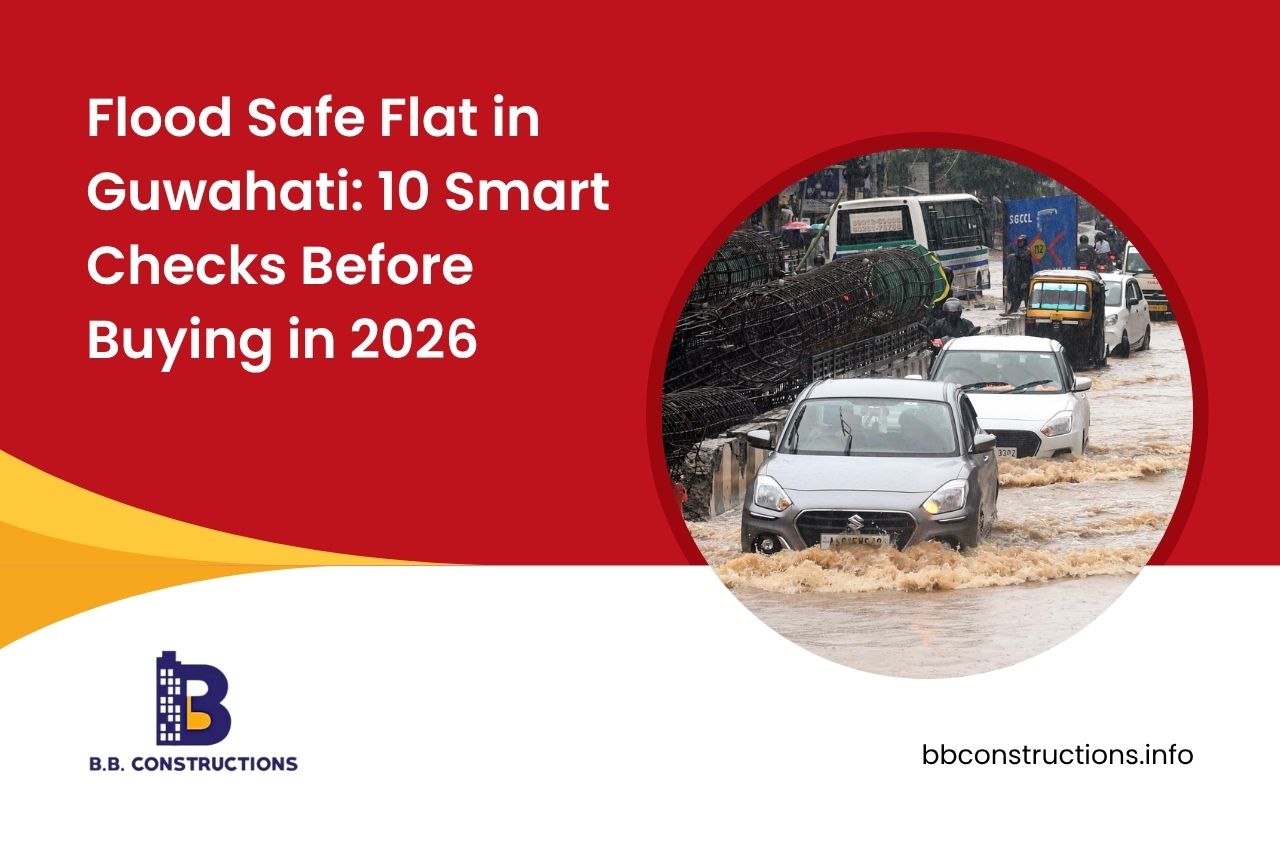
Look around the project entrance, adjoining lanes and main connecting road.
Check whether you notice:
- Standing water
- Overflowing drains
- Mud and heavy silt
- Water entering property entrances
- Waterlogged parking areas
- Difficult pedestrian access
- Blocked drains
- Significant differences between road and property level
You don’t necessarily need to visit during severe weather. Safety comes first. A visit after ordinary heavy rain can still tell you a lot about drainage around a property.
Ask Local Residents
People living nearby can provide useful historical context.
Ask:
“How does this road usually perform during heavy monsoon rain?”
That may produce more useful information than simply asking whether the area “floods.”
2. Check the Elevation of Your Flood Safe Flat in Guwahati
Site elevation matters.
Don’t confuse your apartment floor with the elevation of the overall property.
Buying an apartment on the eighth floor doesn’t automatically remove every consequence of ground-level waterlogging.
If the ground level is affected, residents can potentially face problems with:
- Vehicle access
- Parking
- Building entrance
- Electrical infrastructure
- Lifts
- Deliveries
- Emergency access
Look at how the building’s plinth and entrance compare with the adjoining road.
If the road appears significantly higher than important ground-level areas, ask how stormwater is prevented from flowing into the property.
3. Inspect the Apartment’s Drainage System
Drainage should be one of your most important checks when evaluating a Flood Safe Flat in Guwahati.
Ask the developer:
Where does rainwater from the project go?
You want to understand the path water takes from:
Roof → Building → Site → Drain → External drainage network
Inspect visible drainage infrastructure around the project.
Look for:
- Stormwater drains
- Properly graded surfaces
- Drain covers
- Water outlets
- Rainwater downpipes
- Clear discharge paths
- Signs of repeated water accumulation
The Government of Assam has identified drainage and stormwater management as important components of addressing Guwahati’s urban waterlogging problem.
4. Check Basement and Parking Flood Protection
Basements and low-level parking deserve special attention.
Ask whether the project has basement or semi-basement parking.
If yes, inspect:
- Ramp slope
- Ramp entrance level
- Drainage channels
- Sump arrangements
- Water pumps
- Backup power
- Location of important electrical equipment
Ask a straightforward question:
“If rainwater reaches the parking ramp, what prevents it from entering the basement?”
The developer should be able to explain the project’s water-management system clearly.
Don’t Only Protect the Flat
A home may be several floors above ground, but your vehicle and essential building systems may not be.
Flood-resilient property selection therefore requires looking at the entire building rather than only your apartment.
5. Check All-Weather Road Access
A Flood Safe Flat in Guwahati should ideally remain reasonably accessible during normal monsoon conditions.
Check the route from the property to the nearest major road.
A building may itself remain unaffected while the approach road becomes difficult to use.
During your site visit, check:
- Width of approach road
- Road elevation
- Roadside drainage
- Low points along the route
- Alternative access routes
- Condition of connecting roads
Try checking more than one approach route where alternatives exist.
This matters particularly for families who require daily access to schools, offices and healthcare facilities.
6. Check Nearby Drains, Channels and Water Bodies
Nearby water bodies aren’t automatically a negative feature.
Natural water systems can play an important role in urban drainage and water retention.
What matters to a buyer is understanding the surrounding geography.
Look at the property on a map and during a physical visit.
Observe whether the property is close to:
- Major drains
- Natural channels
- Wetlands
- Streams
- Low-lying land
- Hill slopes
Ask how stormwater from the project ultimately reaches the larger drainage network.
The Assam government’s flood-mitigation work in Guwahati includes water-body conservation and stormwater drainage measures, highlighting the relationship between natural water systems and urban flood management.
7. Ask About the Property’s Waterlogging History
When assessing a Flood Safe Flat in Guwahati, historical performance is extremely useful.
If the building has already experienced several monsoons, ask existing residents or nearby businesses what happened during periods of heavy rain.
Useful questions include:
Did water ever enter the compound?
Has the parking area experienced waterlogging?
Does the entrance road remain accessible?
How quickly does accumulated water normally drain away?
Have lifts or power systems ever been affected by water?
For an under-construction property without historical performance, pay even closer attention to site planning, elevation and drainage design.
8. Check Where Electrical Equipment Is Located
Water and critical electrical infrastructure are a poor combination.
When evaluating a Flood Safe Flat in Guwahati, ask where important building systems are installed.
These may include:
- Electrical panels
- Transformers
- Generator systems
- Lift control equipment
- Pumps
- Backup systems
You don’t need to become an engineer.
Simply ask the project team to explain how essential infrastructure is protected from water ingress and what happens during prolonged power failure.
9. Understand Rainwater Management Inside the Project
A large residential development has significant roof and paved surface area.
During intense rainfall, that water has to go somewhere.
Ask about the project’s:
- Roof drainage
- Stormwater drainage
- Rainwater harvesting
- Surface grading
- Recharge systems, where applicable
- Sumps and pumps, where applicable
A good drainage strategy should move water away from vulnerable building areas rather than allowing it to accumulate near entrances and foundations.
10. Check Emergency Accessibility
Flood safety is also about accessibility.
Ask yourself:
If there is heavy rain, can an ambulance or emergency vehicle reasonably reach this property?
Consider connectivity to:
- Main roads
- Hospitals
- Pharmacies
- Public transport
- Alternative routes
This is particularly relevant for families with children or elderly family members.
A premium-looking apartment loses some of its practical value if residents frequently struggle to reach or leave the property during normal seasonal rainfall.
Flood Safe Flat in Guwahati: A 10-Point Buyer Checklist
Before booking, check:
✓ Property elevation
✓ Road elevation
✓ Stormwater drainage
✓ Basement protection
✓ Parking drainage
✓ Rainwater management
✓ Main road accessibility
✓ Alternative access
✓ Location of electrical infrastructure
✓ Past waterlogging history
Take photographs during your site inspection so you can compare multiple properties later.
What Does the Government Say About Guwahati Waterlogging?
The issue is significant enough that the Government of Assam operates Mission Flood Free Guwahati.
Government information identifies recurrent flood inundation and severe waterlogging during storm events, particularly in the rainy season.
Factors identified include urban development, reduction of wetland areas, clogged drainage systems, low-lying areas and stormwater from surrounding hills.
Government mitigation activities include drainage-channel desiltation, water-body conservation, stormwater drains and pumping arrangements.
Homebuyers should therefore treat drainage as a legitimate property-selection factor rather than an inconvenience to consider only after moving in.
Flood Safety vs Earthquake Safety: Check Both
Searching for a Flood Safe Flat in Guwahati should not mean ignoring structural safety.
Guwahati also faces seismic risk.
A comprehensive home-buying assessment should therefore consider:
Flood resilience + Structural safety + Legal compliance + Construction quality + Location
Read our guide on [Earthquake Resistant Building in India] to understand what buyers should know about earthquake-conscious construction.
Buying a Flat in Guwahati? Don’t Judge a Property on One Factor
Flood safety is important, but it should form part of a larger due-diligence process.
A suitable home should ideally offer a balance of:
Location
Good connectivity to the places your family regularly visits.
Construction Quality
Appropriate materials, workmanship and structural planning.
Legal Clarity
Relevant approvals and documentation should be checked before purchasing.
Usable Space
Compare carpet area and layout rather than looking only at the headline square footage.
Drainage & Accessibility
Understand how the property performs during Guwahati’s monsoon conditions.
Budget
Consider the complete acquisition cost rather than only the advertised selling price.
For a broader buying overview, read our [Properties for Sale in Guwahati: Complete 2026 Buyer’s Guide].
Should You Avoid Every Low-Lying Area in Guwahati?
Not necessarily.
A property’s actual performance depends on multiple factors, including site-specific drainage, elevation, access and surrounding infrastructure.
It would therefore be misleading to declare an entire locality “flood safe” or “flood prone” based only on its name.
Even properties within the same neighbourhood can have different site conditions.
Evaluate the specific project and its immediate surroundings.
This is a much more reliable approach than choosing or rejecting a locality based on a generic internet list.
Questions to Ask the Developer Before Booking
When visiting a property, ask:
1. What is the site’s elevation compared with the adjoining road?
2. Where does the project’s stormwater discharge?
3. Has the site experienced waterlogging in previous monsoons?
4. How is basement parking protected from rainwater?
5. Are pumps installed for accumulated stormwater?
6. Is backup power available for critical pumps?
7. Where are major electrical systems located?
8. What happens if the external municipal drain is temporarily full?
9. Is there an alternative road to reach the project?
10. Can I visit the property again during the monsoon?
A credible developer should be comfortable discussing practical questions about the property.
Finding a Flood Safe Flat in Guwahati with B.B. Constructions
When searching for a Flood Safe Flat in Guwahati, don’t rely solely on online photographs.
Visit the property.
Inspect its surroundings.
Check the approach road.
Understand the drainage.
Review project specifications.
And ask questions.
B.B. Constructions develops residential and commercial properties in Guwahati, including completed and ongoing residential projects.
Explore [B.B. Constructions’ residential properties in Guwahati] and schedule a site visit to evaluate the project location, layout, specifications and amenities for yourself.
Frequently Asked Questions
How do I check a Flood Safe Flat in Guwahati?
To evaluate a Flood Safe Flat in Guwahati, inspect site elevation, stormwater drainage, basement parking, approach roads, surrounding land levels and past waterlogging history. Visiting the location during or shortly after ordinary heavy rainfall can also provide useful information.
Which areas of Guwahati are flood safe?
Flood and waterlogging conditions can vary significantly within a locality. Instead of relying solely on a neighbourhood-level label, evaluate the specific property, surrounding roads, elevation, drainage and historical conditions.
Does buying a flat on a higher floor solve flood risk?
Not completely. A higher-floor apartment may keep the residential unit away from ground-level water, but parking, entrances, lifts, electrical systems and access roads can still potentially be affected.
How can I check waterlogging before buying a flat?
Visit the locality after heavy rainfall, inspect surrounding roads and drains, speak with existing residents or nearby businesses, and ask the developer about the property’s past monsoon performance.
Is drainage important when buying a flat in Guwahati?
Yes. Guwahati experiences recurrent urban waterlogging, making site drainage and surrounding stormwater infrastructure important considerations when evaluating a residential property.
Should I buy property near a water body?
The presence of a water body alone does not determine whether a property is suitable. Buyers should understand the site’s elevation, drainage, applicable development rules and surrounding geography before making a decision.
What should I ask a builder about flood safety?
Ask about site elevation, stormwater discharge, basement protection, pumps, backup power, previous waterlogging, road accessibility and the location of critical electrical equipment.
Final Takeaway
Choosing a Flood Safe Flat in Guwahati requires looking beyond the apartment itself.
Evaluate the site, drainage, road, parking, surrounding geography and monsoon accessibility before making a purchase.
Most importantly, don’t depend solely on claims such as “no waterlogging area” in advertisements.
Visit the location. Ask residents. Check the drainage. Understand the elevation. And inspect the property under realistic monsoon conditions.
Those few extra checks before booking can help you make a much more informed property decision.